FOR LAB AUTOMATION
Your scientists imagine the experiment
and the agent drives the hardware.
Elnora is the AI agent that drives your lab hardware, writing and simulating the workflow, then moving the instrument once you confirm the deck.
A good idea reaches the bench the day you have it.
The work your team thought of this morning is running this afternoon, and the machines you bought stay busy.
What Elnora does for lab automation
A sentence in plain English becomes a workflow.
Elnora writes it in your company’s SDK, following PyLabRobot, Anthropic’s Model Hardware Protocol and whichever standard comes next, so your engineers own the code.
A person confirms the deck before the run starts.
The simulation runs the whole workflow in seconds, so what reaches the instrument has already run start to finish.
Your bench scientists start the runs themselves.
Whoever designed the experiment asks for the run, and your specialists keep the hard assays.
The hardware run
Scientists can now control the instruments already on your bench.
In the video, Elnora uses the UniteLabs SDK to control a Hamilton Microlab STAR.
Microlab STAR plate transfer workflow
On Microlab STAR - Max I want to move the plate from the front position to the back one. Design me a workflow and run it.
AGENT ACTIVITY (41)
Analysing your request
Loading skills
Unitelabs list services
List lab workflows
Running computation
Get lab workflow
Unitelabs list workflows
The simulation run completed successfully. I am ready to run this on the physical Microlab STAR - Max. Please confirm the physical STAR deck matches the deck layout:
- APE carrier loaded
- plate_1 seated at APECarrier[4]
- APECarrier[0] is FREE
Reply “Ready” when the plate is seated and it is safe to move.
ready
AGENT ACTIVITY (14)
1m 48sAnalysing your request
Unitelabs run workflow
Unitelabs get run
Unitelabs control run
The plate moved from the front position (APECarrier[4]) to the back position (APECarrier[0]) on the Microlab STAR - Max. The timeline and the logs are in the run panel.
Hamilton Microlab STAR
Microlab STAR - Max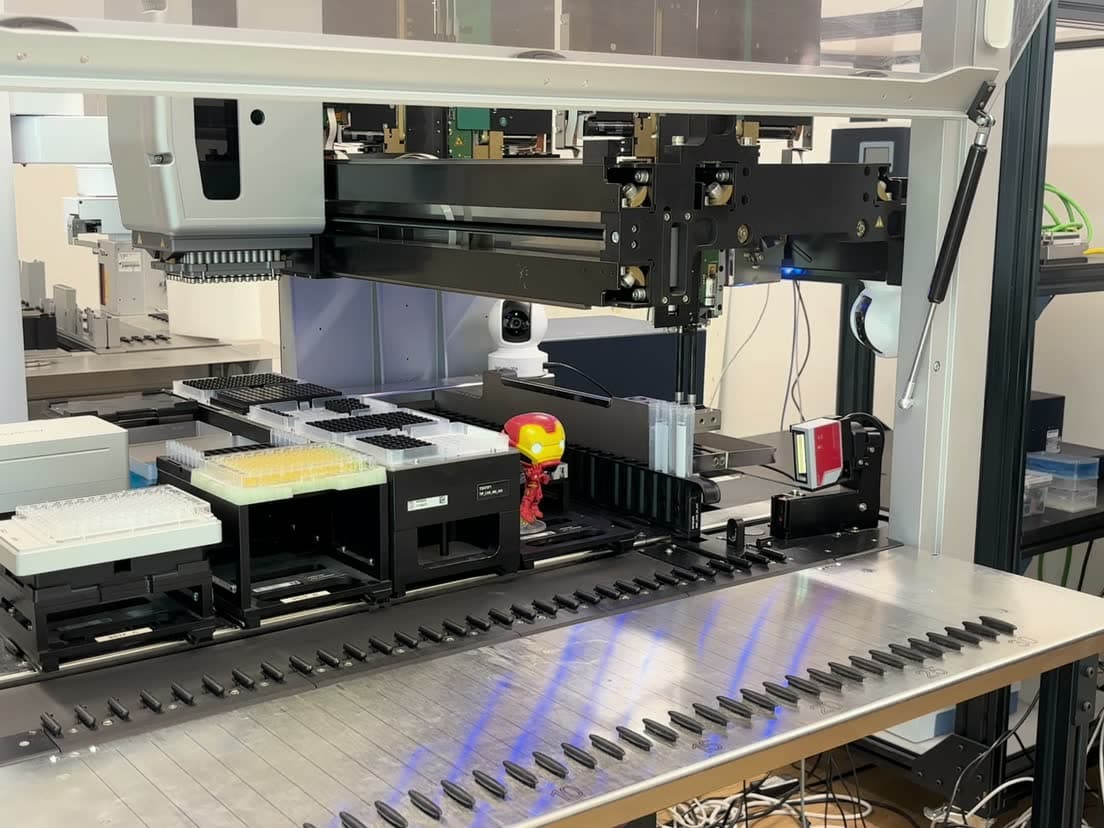
Deck loaded
- AskA scientist describes the run in plain English, and Elnora has the protocol ready.
- WriteElnora writes the workflow in the SDK your company already uses or in Anthropic’s Model Hardware Protocol, and runs it in simulation.
- ConfirmThe run pauses and prints the deck it expects, position by position, and the operator replies once the bench matches.
- RunThe arm carries it out, and the phases, the durations and the logs come back.
THE CONNECTION
One line from the scientist to the instrument.
A scientist describes the experiment, Elnora writes it in the SDK your instruments speak, and the hardware runs it. The results come back the same way.
What Elnora doesMicrolab STAR - Max
CoRe gripperplate_1 APECarrier[4] APECarrier[0]
Deck confirmed
VISIBILITY
You follow the agent through the run.
The steps are there to read in simulation and again on the hardware: what ran, in what order, how long each took, and what the instrument reported back.
What Elnora doesPhase 01: Move Plate to Back
CompletedPlate transfer complete
Next steps
Bring your hardware, and Elnora writes in your standard.
Elnora's engineers do the connecting, and your team brings the instruments and the experiment to run on them.
- You name the standard we write inElnora writes in the one your team already uses, or the one you want next.
- We spend a few days in your labWe set the scope with you, then work beside your scientists on your own hardware until the first method is running.
- We get the whole lab connectedWhat worked on the first machine carries to the next, and we keep going until your lab runs the same way.
Questions about Elnora for lab automation
Can an AI agent control lab hardware?
Yes. At a buildathon in Munich, Elnora took a scientist’s sentence, wrote the workflow, simulated it, and moved a plate on a Hamilton Microlab STAR.
How does an AI agent reach instruments a lab owns?
Elnora reaches your instruments through the automation platform that already controls them. The agent signs in to your account there, reads what it finds, and writes the workflow in the SDK that platform uses.
What stops an AI agent crashing an instrument?
Elnora simulates the workflow first, and a person confirms the deck it prints before the hardware starts, because the positions differ from one instrument to the next.
Can an AI agent connect to lab hardware with PyLabRobot, the UniteLabs SDK or Anthropic’s Model Hardware Protocol?
Yes. Elnora connects through PyLabRobot, the UniteLabs SDK and Anthropic’s Model Hardware Protocol, or MHP, through the SDK your instruments already speak, and through whichever standard arrives next.
Is an AI agent that moves lab hardware safe on our network?
Yes. The code Elnora writes runs in an isolated per-task sandbox whose network reach stops at an approved list of scientific hosts, and your platform credential is injected server-side so it never enters the model’s context. Customer data never trains a model.